RoboKeeper: A Goalkeeper Robot
A depth camera spots an incoming ball, an Extended Kalman Filter predicts where it will cross the goal line, and a servo swings the keeper there - built for the IESL Techno 2025 exhibition.
- ROS 2 Jazzy
- Python
- Orbbec Astra Pro
- OpenCV
- YOLOv8
- Extended Kalman Filter
- ESP32
- Servo control
The problem
Someone kicks a ball at a goal. A robot keeper has a fraction of a second to decide where to be - and it cannot wait to see where the ball arrives, because by then it is too late to move. It has to watch the first part of the flight and predict the rest.
A team project for the IESL Techno 2025 exhibition, built at the University of Moratuwa with L. G. L. Kavinda and A. Disanayake.
How it works
A keeper figure is mounted on the shaft of a servo, so it swings about a horizontal axis to cover the goal. Everything else is a pipeline of ROS 2 Jazzy nodes:
Astra Pro  colour + depth
  → detector   ball in 3D
  → EKF        goal crossing
  → servo      ESP32, USB serial
  → keeper swings
Seeing the ball. An Orbbec Astra Pro RGB-D camera sits above the crossbar, behind the goal and centred on it, looking down the pitch at the kicker - high enough that the keeper never blocks its view of the ball. Each colour frame is paired with its depth frame, so a ball found in the image also has a distance - together, a position in three dimensions. The first detector used HSV colour thresholding and contours to find the red ball; the final one uses a custom-trained YOLOv8 model, which does not depend on the ball's colour surviving the room's lighting.
Two gates, not a stream. Rather than tracking the ball continuously, the detector waits for it to pass two distances from the camera: it remembers the ball's position at the far gate, and when the ball reaches the near gate it publishes the pair as one trajectory. Two well-chosen points are enough for the filter to work with, and far cheaper than following every frame.
Predicting the rest. An Extended Kalman Filter with a six-value state - position and velocity in three axes - takes those measurements, with gravity built into its motion model, so it predicts an arc rather than a straight line. It then steps the filter forward until the ball reaches the plane of the goal, converts the predicted crossing point into a keeper angle, and publishes it.
Moving the keeper. A servo-driver node sends that angle over USB serial to an ESP32, which drives the servo. Every prediction is also logged to CSV and plotted, for tuning the filter.
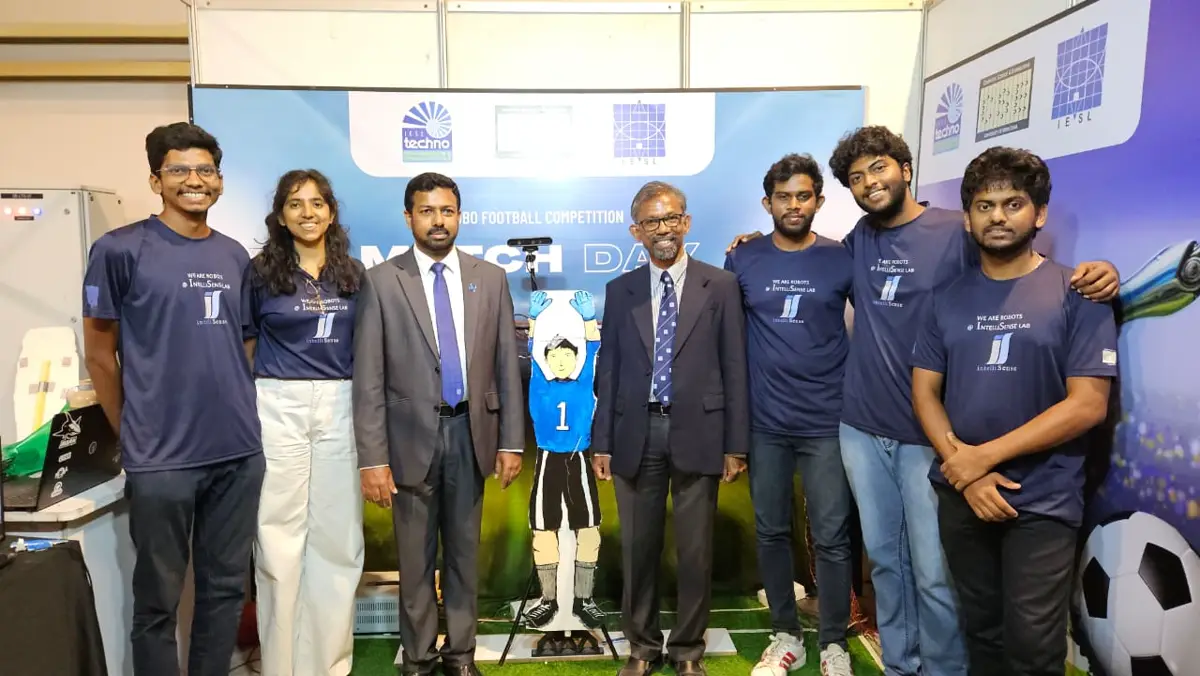
At Techno 2025
My part
I brought the camera up. The Astra Pro is an older model that the current Orbbec ROS 2
driver only half supports, and getting it working on ROS 2 Jazzy and Ubuntu 24.04 took
some digging: the right driver branch, running it as a USB 2.0 device, a depth format
(Y11) the defaults don't expect, frame sync switched off because the model doesn't support
it, and a fix for camera-info messages that publish NaNs. I wrote that up as the team's
setup guide and packaged it as a one-command bring-up launch.
On top of that I wrote the first red-ball detector: HSV thresholding on the colour image, synchronised with the depth image to publish the ball's 3D position and distance, with a debug view showing what it saw. It was the baseline the later YOLO detector replaced.
Take the shot yourself
I built an interactive simulation of the interception problem - a ball, two camera sightings, and a servo with milliseconds to move. Aim it, then switch the keeper between the Kalman filter and a straight line through the two points and take the same shot again.
The straight line is the one worth trying. It is not a strawman: two points really do define a line, and the line really does pass through both sightings. It just ignores that the ball is falling, so it predicts a crossing above the real one and the keeper reaches over the top of the shot. The slower the shot, the further it falls in the last two metres, and the worse the miss.
The other two sliders are the constraints the real robot lived under. Camera noise goes almost straight through to the prediction, because two sightings give the filter nothing to average. And moving the near gate toward the goal shrinks the reaction time until the servo cannot finish its swing - a right answer that arrives too late is still a goal.
What I took from it
A prediction problem hides inside most "just react to it" robotics problems. The keeper never catches up with the ball; it gets there first. And the unglamorous part - making a camera produce trustworthy depth at all - is what everything else stood on.