Procurement Intelligence for ACL Cables
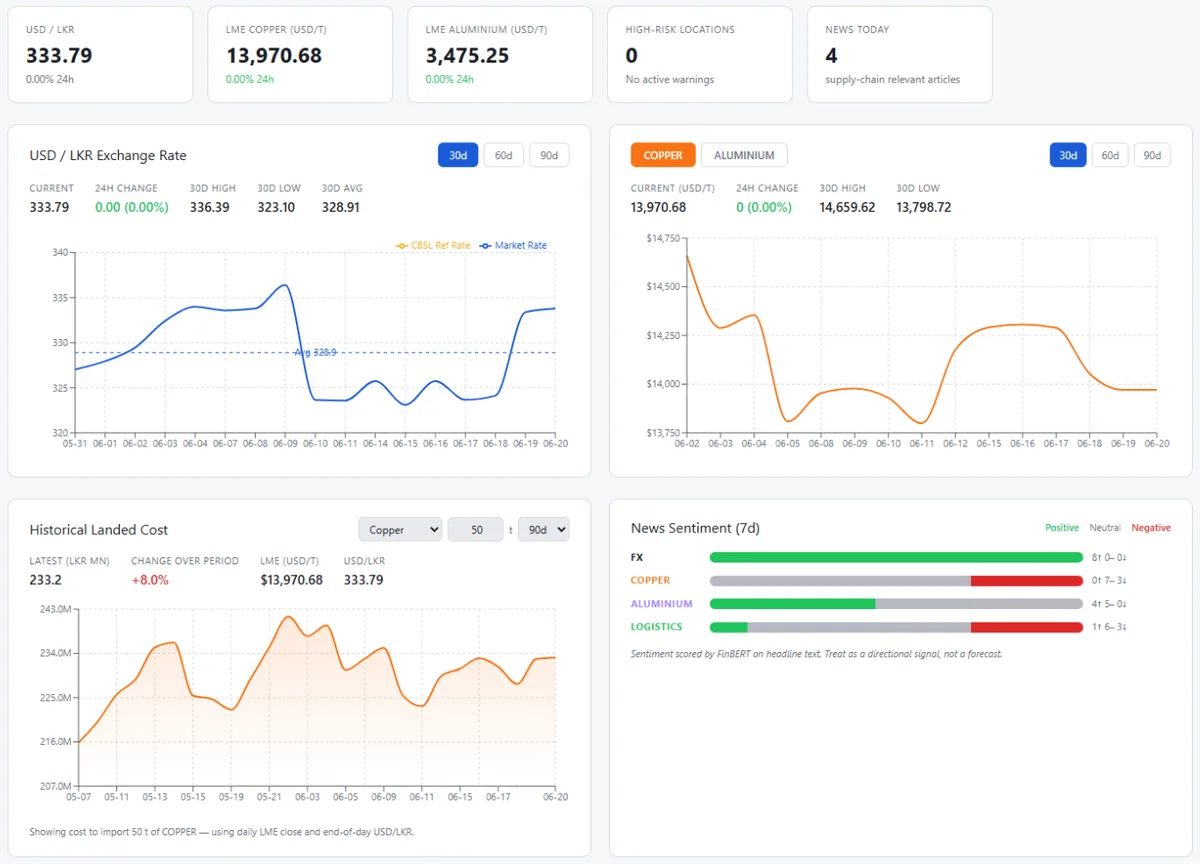
A decision-support dashboard for Sri Lanka's largest cable maker - live USD/LKR, LME copper and aluminium, flood and drought risk, and news sentiment from a FinBERT model retuned to read the news as a buyer would. Built by a team of five and demoed to ACL.
- Python
- FastAPI
- APScheduler
- FinBERT / PyTorch
- PostgreSQL + TimescaleDB
- React / TypeScript
- Recharts
- Leaflet
- Docker
- Cloudflare Tunnel
The problem
ACL Cables PLC imports most of its copper, aluminium and XLPE from the UAE, China, Singapore and Vietnam. Every order is exposed to the USD/LKR rate, to metal prices on the London Metal Exchange, to trouble in supplier countries and to monsoon flooding at home. The company's own 2024/25 Annual Report lists exchange-rate, country, operational and climate risk on its risk register, and every one of them was being handled by people checking things by hand.
This was our sixth-semester professional portfolio project at the University of Moratuwa: a real company, a real brief, and a report written for their procurement and risk team. We took the Annual Report as the requirements document. If a proposed feature could not be traced to a section of it, it did not go in.
Honest framing first
The original idea was a system that would "predict" currency moves. We dropped that early. USD/LKR is a thin, intervention-prone market, and nobody forecasts it reliably from news headlines. What we built instead is an intelligence and alerting tool: it brings the four forces together, labels every number with its source and age, and raises alerts the team configures. The AI part is a signal to look into, and the UI says so.
What it does
Collectors on a schedule. Six jobs run inside the FastAPI process under APScheduler rather than on a separate queue: USD/LKR every 20 minutes, copper and aluminium futures every hour, weather for 13 locations every hour, news every three hours, sentiment scoring every two hours, and a 15-minute pass over the alert rules. Readings land in TimescaleDB hypertables, which is what made a year of backtesting come back in seconds.
Landed cost, not raw price. A 2% fall in copper on the LME means nothing if the rupee fell 3% the same day. The alert engine and the calculator work on what an order would actually cost in rupees: tonnes × LME price × USD/LKR.
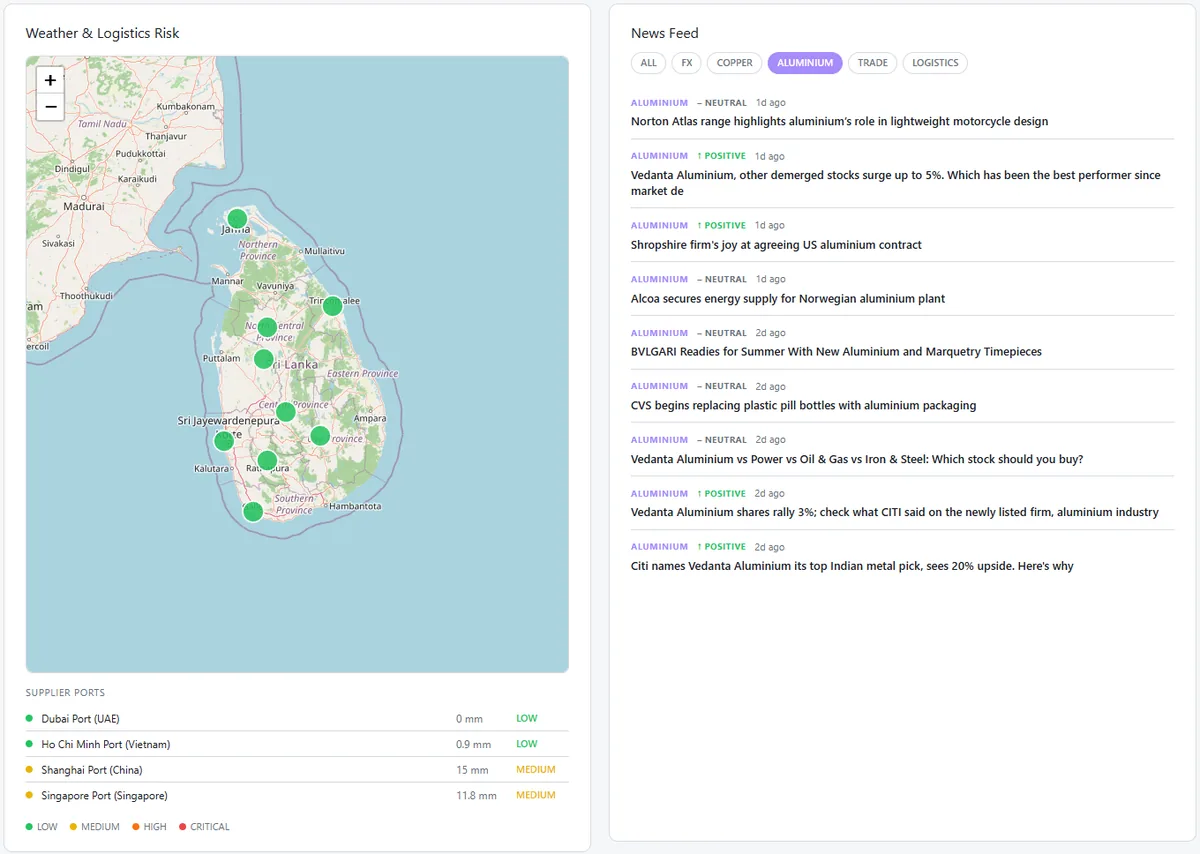
Weather that knows Sri Lanka. Open-Meteo data for all nine provinces and four supplier ports becomes flood, drought and heatwave risk. The flood thresholds and the monsoon baseline had to be tuned for a tropical island. The defaults in most open-source tools assume European weather.
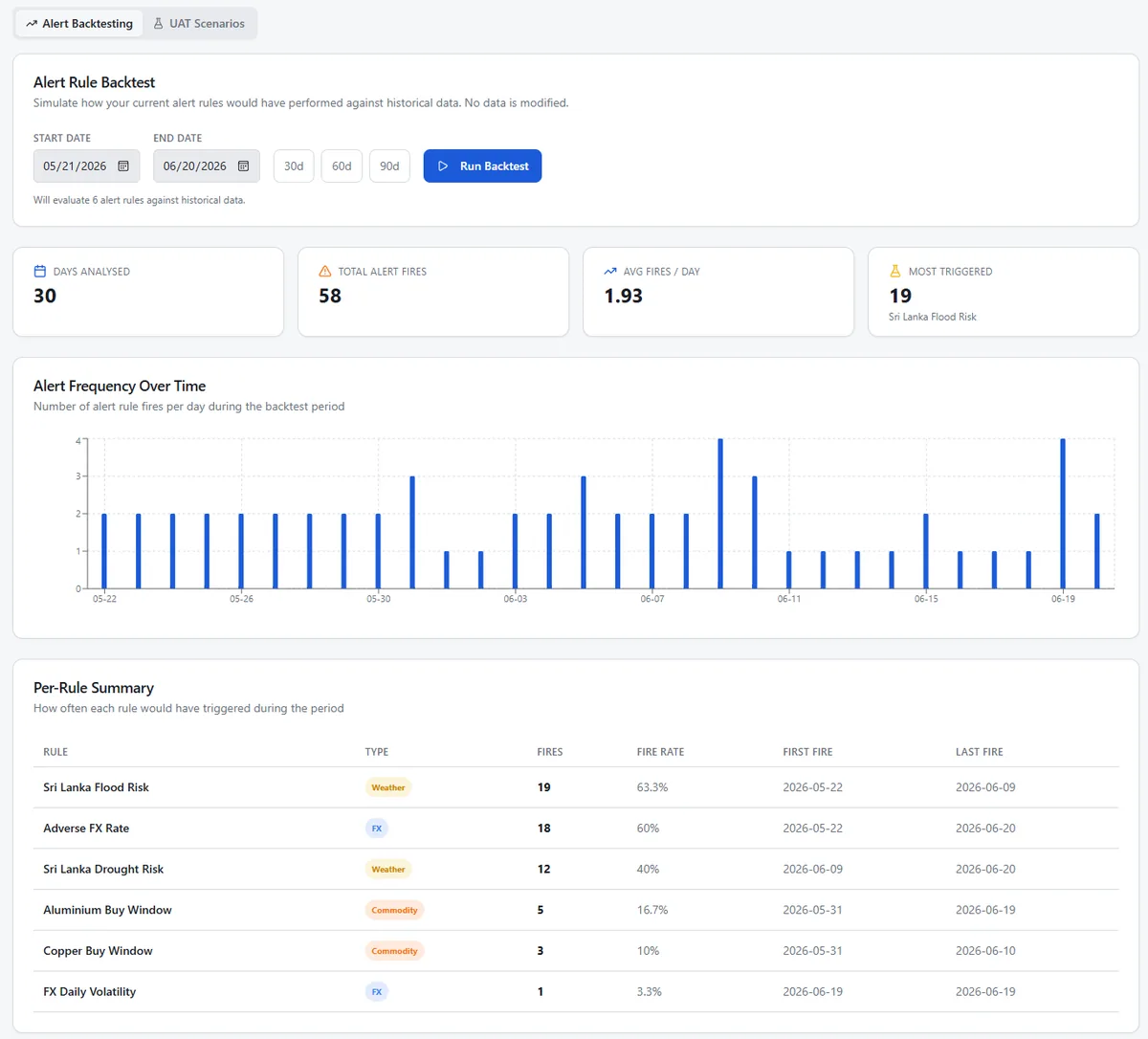
Alerts you can test before you trust them. Rules can be simple thresholds or composite conditions across FX, metals and weather, each with its own email recipients. A composite rule has to see every signal at the same moment, so each evaluation first saves a snapshot of all the latest readings and then checks the rule against that snapshot. A backtest page replays any rule set over past data, so the team can see how noisy a rule would have been before they switch it on.
Climate reporting. Weather events are also logged in a form that can be exported for SLFRS S2 climate disclosures, which ACL has to start reporting against.
Teaching FinBERT to think like a buyer
FinBERT is trained to read the news the way an investor does. "Copper prices surge" is good news to an investor. To someone who has to buy copper next month, it is bad news. The first version simply flipped the label for metal topics. That broke on the cases that matter: a new mine opening is good for a buyer, and the flip turned it into bad news.
So we retrained the model's final layer on buyer-labelled examples: 200 hand-written edge cases across the five topics, plus real articles labelled from a buyer's point of view. The 110M-parameter encoder stayed frozen and only the classifier trained, about 2,300 weights. With a few hundred examples, anything bigger would just memorise them. It reached 58% on a held-out set, against 51.5% for always guessing the most common label. That is not a number to act on alone, which is exactly why the dashboard presents sentiment as a signal rather than advice.
Taking it to ACL
We deployed the stack with Docker Compose on a small VPS behind a Cloudflare Tunnel, so no ports were open to the internet, and walked ACL's Group CIO and their sales and business development managers through the working system at the head office. They told us two things. They had no automated risk or procurement monitoring yet, and managing FX exposure on raw materials was the most pressing problem they had. That confirmed that the FX view is the centre of the tool.
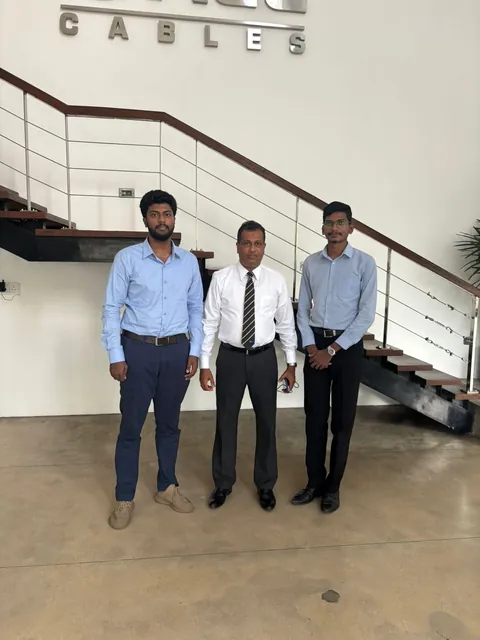
Team NextVision: Savinu Anusara, Isurika Gunasekara, Sasmitha Jayasinghe, Lakshitha Kavinda and me.
What I took from it
Using the client's own Annual Report as the spec settled most arguments before they started. The harder lessons were about definitions. We lost time because "neutral" meant "irrelevant" to one labeller and "mixed" to another, and the labels had to be reconciled before training. Next time I would agree the labelling rules and check that labellers agree before collecting data at scale.